Synogut Guides: Digestive Health and Fiber Supplement Buying
Written by the Synogut editorial team
Last updated · Who reviewed this page · How we write and review
The Synogut guides cover two topics: everyday digestive health, from fiber and fluids to warning signs, and a checklist for choosing a fiber supplement. Three blog posts explain psyllium doses in studies, bentonite clay safety and red flags in gut-supplement ads. A glossary defines twelve label terms.
Synogut guides: two in-depth reads on gut health
The Synogut guides tackle two questions: how to keep digestion on track day to day, and how to pick a fiber supplement if you want one. Both are free and written in everyday words.
Start with the health guide, since food and fluids come first. Move to the checklist only if you still want a product.
Digestive Health Guide: Fiber, Fluids and Warning Signs
How much fiber adults need, which foods have trial data, when bowel changes need a doctor, and why cleanses do not hold up.
Choosing a Fiber Supplement: A Buyer's Checklist
Ten label checks for any fiber product, from grams per serving to the water warning, then applied honestly to Synogut.
Synogut blog: psyllium doses, clay safety and ad red flags
The Synogut blog answers one question per post. Three posts cover what readers ask most about gut capsules.
Each post links its sources, so you can check the studies yourself.
Psyllium for Regularity: How Much Fiber Did Studies Use?
The daily grams in psyllium trials, set beside what a capsule can hold.
Bentonite Clay in Gut Supplements
The FDA lead warning, how clay can bind medicines, and what is still unknown.
Gut-Supplement Ad Red Flags
Bonus e-books, paid press releases, fake reviews and the other signs to slow down.
Which Synogut read fits your question?
Match your question to one read below. Most people need the health guide first and the checklist second.
- Unsure how much fiber you need, or when a change needs a doctor? Read the digestive health guide.
- Comparing two or three fiber labels? Use the fiber supplement checklist.
- Wondering how many grams of psyllium the studies used? Read the psyllium dose post.
- Worried about clay and your medicines? Read the bentonite clay post.
- Not sure an ad or review page is honest? Read the ad red flags post.
Synogut glossary: gut supplement terms in plain English
The Synogut glossary explains twelve words that show up on gut supplement labels and ads. The right column shows where each one touches the Synogut bottle or its sales pages.
Definitions follow the cited sources, such as FDA on label claims (FDA, 2024) and on blends (FDA, 2005).
| Term | What it means | On Synogut |
|---|---|---|
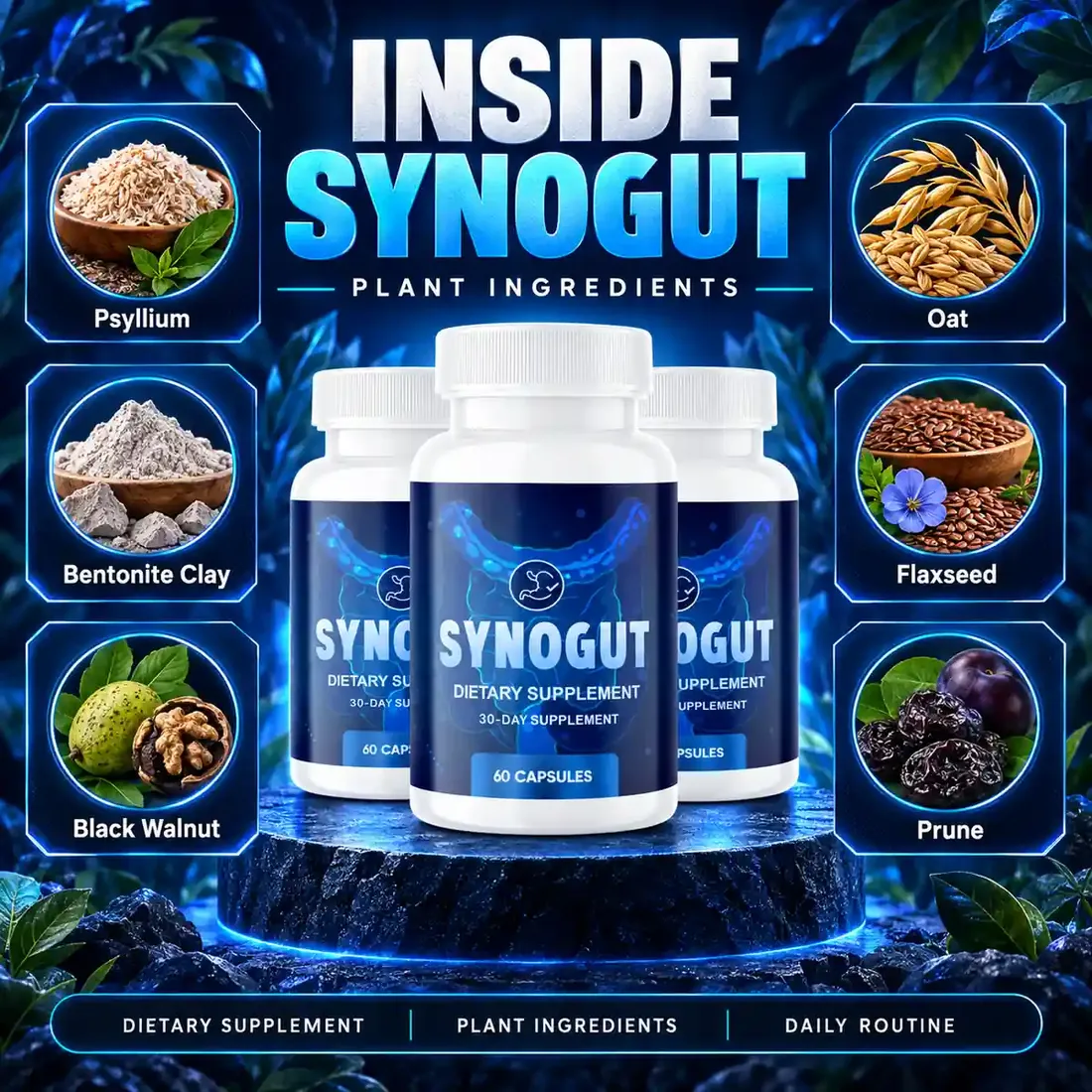
| Psyllium | A plant husk fiber that forms a gel when it takes up water. | Named on the bottle art; amount not stated |
| Soluble fiber | Fiber that mixes with water. Psyllium is the best-studied kind for regularity. | Psyllium, oat and flaxseed carry it |
| Bentonite clay | A volcanic clay that binds water and other substances, which can include medicines. | Named on the bottle art |
| Tannins | Bitter plant compounds, rich in black walnut hull, that may cut drug absorption. | Black walnut on the bottle art |
| Sorbitol | A sugar alcohol that prunes carry along with their fiber. | Prune on the bottle art |
| Beta-glucan | The soluble fiber in oats. FDA ties a heart claim to 3 g a day. | Oat on the bottle art |
| Supplement Facts panel | The label box listing the serving size and each ingredient amount. | Not supplied or published |
| Proprietary blend | A mix shown with one total weight instead of single amounts. | No blend total shown either |
| Structure/function claim | A claim about supporting normal body function, not treating disease. | “Enjoy a smooth gastric transit” |
| FDA-registered facility | A factory listed with FDA. It is not an approval of the product. | Info site says FDA approved; that wording is wrong |
| Gluten-free | A voluntary claim that means under 20 ppm of gluten. | No claim or seal shown |
| Lot number and CoA | A batch code, and a lab report tied to one batch. | SYN-26/GO-6181 and SYN-6181-26-GO, draft labels, not lab proof |
How to read a gut supplement label the Synogut way
The Synogut desk reads every gut label in the same four steps. You can use them on any bottle, in a store or online.
- 1
Find the Supplement Facts panel
Note the serving size and how many servings fill the bottle.
- 2
Read each amount
Look for grams of fiber per serving, or at least a blend total.
- 3
Compare with studies
Fiber trials for constipation used about 10 grams a day or more.
- 4
Scan the claims
Supports wording is normal. Detox, cleanse or cure wording is a red flag.
What the Synogut guides found about the dose
The Synogut guides set the capsule serving beside the doses in human studies. Every studied amount is far above what two capsules can hold.
That does not make the capsules unsafe. It means study results cannot predict what this bottle will do.
- Psyllium: about 10 to 19 grams a day in trials (fibre meta-analysis, 2016), with benefit above 10 grams a day for 4 weeks or more (van et al., 2022)
- Prunes: 80 to 120 grams of whole fruit a day (Lever et al., 2019)
- Flaxseed: about 10 grams a day in one small trial (Soltanian et al., 2018)
- Two capsules: likely 1 to 2 grams of all ingredients combined, an estimate from capsule size (UNC Pharmlabs, n.d.)
How the Synogut guides use research
The Synogut guides lean on clinical guidelines, pooled trial reviews and government fact sheets. Each research line names the dose and links the source.
The guides also report findings that cut against the product. The 2023 constipation guideline found psyllium the only fiber supplement that appeared effective (Chang et al., 2023), and it did not test capsule blends.
Guidelines
Expert advice on what to try first for chronic constipation.
Reviews
Studies that pool many trials and weigh their quality.
Fact sheets
NIH, NCCIH and FDA pages on safety and label rules.
Who writes and checks the Synogut guides?
Every guide and post comes from the Synogut editorial team. The team works only from the bottle art, the seller's materials, the linked studies and NIH, NCCIH and FDA pages.
A medical review box sits at the foot of each guide for our medical reviewer. Its name and date fields stay as highlighted blanks until a qualified person has truly checked that guide.
Sources move and links break. When that happens, the claim is checked again and the date changes, and any line that no longer traces to a source is cut.
Readers help too. A note to the website inbox about a broken link or a confusing sentence gets the page rechecked.
What the Synogut guides will not tell you
The Synogut guides stick to what the sources support. Some things never appear, however often people search for them.
- That a capsule treats constipation, IBS, IBD or parasites
- That clay or a cleanse pulls toxins out of your body
- A results timeline the seller never published
- A customer rating or review that nobody has verified
Questions about the Synogut guides
Questions people type into Google and Bing, answered from the label and the sources on this page.
Do the Synogut guides cost anything?
Nothing. Every guide and blog post is open to read, with no account, email box or paywall in the way.
Are the Synogut guides medical advice?
No. They put public research and bottle facts into everyday words. Your own bowel habits, test results and medicines are a talk for your doctor.
Which Synogut guide should I read first?
Start with the digestive health guide. Food fiber, fluids and knowing the warning signs matter more than any capsule.
Do the Synogut guides say the capsules work?
No. They describe studies of single ingredients such as psyllium and prunes, not of the finished formula. They also show how far a capsule serving falls below those study doses.
What is the difference between a fiber supplement and a laxative drug?
A fiber supplement is sold as food under supplement rules, with claims FDA does not review first (FDA, 2024). A laxative drug follows drug rules, and fiber drugs such as psyllium must carry a water and choking warning (21 CFR 201.319, n.d.).
Why do the guides keep saying amount not stated?
Because Synogut publishes no Supplement Facts panel. Without it, nobody can say how much psyllium, prune or clay each serving holds.
Do the Synogut guides cover IBS or bowel disease?
Only to say that a supplement is not a treatment for them. IBS, IBD and other bowel diseases need care from a doctor.
What is a CFU on a probiotic label?
CFU stands for colony-forming units, a count of live microbes. Results depend on the exact strain and dose (NCCIH, 2019), and Synogut gives neither.
How often are the Synogut guides checked?
Every source link was rechecked on October 13, 2026. The date under each guide title shows its latest review.
Can I suggest a topic for the Synogut guides?
Please do. Send your question to [email protected], and the most common reader questions become the next posts.