Psyllium for Regularity: How Much Fiber Did the Studies Use?
Written by the Synogut editorial team
Last updated · Who reviewed this page · How we write and review
Psyllium trials for constipation gave about 10 to 19 grams of fiber a day, and a 2022 review saw a benefit only above 10 grams a day for 4 weeks or more. A large capsule holds under 1 gram. Synogut prints no psyllium amount, and the 2 capsules a day its bottle math implies likely hold about 1 to 2 grams of everything combined.
How much psyllium did constipation studies use?
Most psyllium studies for constipation used about 10 to 19 grams a day. A 2022 review found that fiber helped only at doses above 10 grams a day, taken for at least 4 weeks.
That review pooled 16 randomized trials with 1,251 adults who had chronic constipation (van et al., 2022). Psyllium and pectin made up most of the fiber tested. People had more gas on fiber, and the trials differed a lot in design.
So the number to remember is grams, not capsules. A label that does not print grams per serving gives you nothing to compare with these studies.
Which psyllium and fiber trials used which doses?
The trials people cite most gave fiber in amounts you would measure with a spoon. Here is how the main ones compare.
| Study | Who and how long | Daily fiber dose | What it found |
|---|---|---|---|
| van der Schoot et al., 2022 | 16 trials, 1,251 adults | Benefit above 10 g | Fiber helped, mainly psyllium and pectin; more gas |
| Fiber meta-analysis, 2016 | 7 trials, 430 adults | 10 to 22.5 g; psyllium 10.2 and 19.2 g | 77% responded on fiber vs 44% on placebo |
| Attaluri et al., 2011 | 40 adults, 3 weeks per treatment | About 6 g, from prunes or psyllium | Prunes did a bit better; gains faded after stopping |
| Lever et al., 2019 | 120 healthy adults, 4 weeks | 80 or 120 g of whole prunes | Heavier stools than water alone; more gas |
The 2016 review looked at seven trials (Alimentary Pharmacology & Therapeutics, 2016). Two of them gave psyllium at 10.2 and 19.2 grams a day. Fiber raised stool frequency and softened stools, though gas showed up more often than on placebo.
What does the 2023 constipation guideline say about psyllium?
It suggests fiber supplements for chronic constipation, and psyllium was the only fiber supplement that looked effective. The recommendation is conditional, which means the evidence is useful but not strong.
The guideline comes from the two big U.S. gut doctor groups (Chang et al., 2023). It does not name a set fiber dose, so the trial amounts above are the best yardstick you have.
Food still comes first, and most of your daily fiber should come from meals. Our digestive health and regularity guide covers daily fiber targets, water and movement.
How long did psyllium studies run before judging results?
The trials ran for weeks before anyone measured success. The 2022 review tied the benefit to at least 4 weeks of steady use.
- Weeks 1-3
Settling in
Gas and bloating are most likely as fiber rises. The prune and psyllium trial judged each treatment after 3 weeks.
- Weeks 4+
Where benefits showed
The 2022 review found the fiber effect with 4 or more weeks of use above 10 grams a day.
- After stopping
Gains can fade
In the prune and psyllium trial, the benefits faded once people stopped.
No trial promises a set day when things change. Keep a simple log of how often you go and how it feels, so you judge by notes instead of memory.
Do prunes work better than psyllium?
In one small head-to-head trial, prunes did slightly better than psyllium at the same fiber dose. That trial had 40 adults, and a prune industry board paid for it.
Each treatment gave about 6 grams of fiber a day for 3 weeks (Attaluri et al., 2011). Prunes raised complete bowel movements a little more than psyllium. Benefits from both faded after people stopped.
A larger 2019 trial gave healthy adults 80 or 120 grams of whole prunes a day for 4 weeks (Lever et al., 2019). Stool weight went up compared with water alone, and so did gas. Prunes also carry sorbitol, which may explain part of the effect.
How much fiber can a capsule hold?
Not much. Even a large size 00 capsule holds under 1 gram of a dense powder, so two capsules hold only a small part of a 10-gram dose.
A pharmacy school guide lists a size 00 capsule at 0.95 mL, which fits about 929 mg of lactose powder (UNC Pharmlabs, n.d.). The bigger size 000 fits about 1,340 mg. Fiber husk is usually lighter than lactose, so it fills a capsule with less weight.
- 1
Find grams per serving
Look for the psyllium line in the Supplement Facts panel. No line means no number to work with.
- 2
Count capsules per serving
Divide the bottle count by the days it is meant to last if the serving is not printed.
- 3
Multiply to a daily total
Grams per serving times servings per day gives your daily fiber from the product.
- 4
Hold it up to the trials
Compare with the 10 to 19 grams a day the psyllium trials used.
How much psyllium is in Synogut?

The amount is not stated. No Supplement Facts panel for Synogut was supplied or published, so the psyllium share, the serving size and every other amount are unknown.
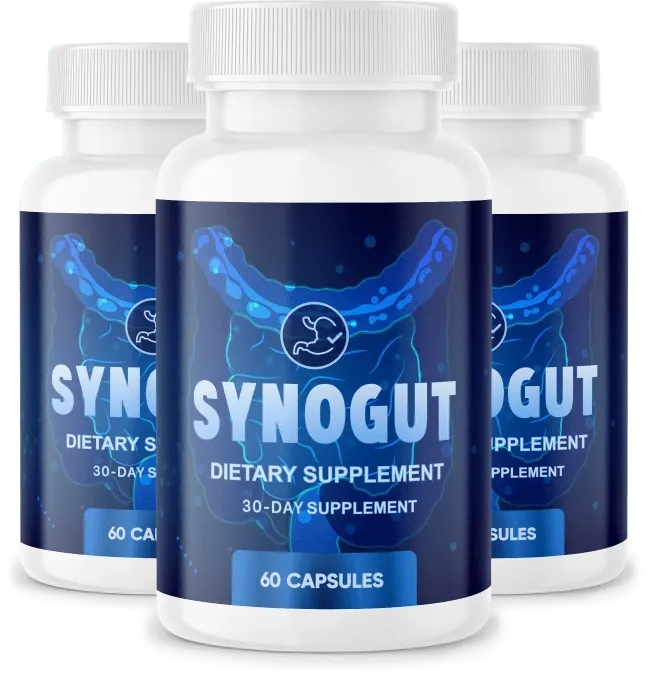
The bottle reads 60 capsules and 30-Day Supplement. That math works out to 2 capsules a day, so confirm the serving on your back label. Based on capsule size alone, we estimate 2 capsules hold about 1 to 2 grams of all six ingredients combined. That is our estimate, not a label figure.
The ingredient list is not settled either. The bottle art shows six ingredients, while the info site’s text lists ten. Our Synogut label page explains what is missing and what to check on your bottle.
How do you take psyllium without trouble?
Take every dose with a full glass of water and add fiber slowly. Psyllium swells as it soaks up fluid, so too little water can cause it to block the throat.
Drug labels for psyllium must warn about choking and tell you to take it with at least 8 ounces of water or other fluid (21 CFR 201.319, n.d.). People who have trouble swallowing should not take fiber capsules.
Psyllium can also slow how your body takes up some medicines. MedlinePlus says to keep it about 3 hours apart from digoxin, aspirin and nitrofurantoin, and to space it from other medicines too (MedlinePlus, 2024). Ask your pharmacist how to time it with what you take.
Our guide to choosing a fiber supplement compares powders, capsules and fiber types side by side.
Where does a capsule like Synogut fit next to study doses?
Think of Synogut as a small, mixed plant capsule, not a copy of a trial dose. It does not claim to match the 10 grams or more of psyllium the studies used, and no study has tested the finished formula.
If you want a study-sized amount of psyllium, a measured powder from a label that prints grams is the closer match. Talk with your doctor first if you take daily medicines.
Some people still prefer a simple capsule routine alongside a fiber-rich diet. If that is you, the Synogut pricing page lists the 2, 3 and 6 bottle packs and the 60-day money-back terms. Check the ingredient list on the bottle you receive.
Psyllium doses: common questions
Questions people type into Google and Bing, answered from the label and the sources on this page.
How much psyllium should I take for constipation?
No official dose exists for supplements, and the 2023 constipation guideline does not set one. In trials, psyllium was given at about 10 to 19 grams a day. Follow your product label and ask your doctor before you go higher.
How many grams of psyllium is in a capsule?
Check the Supplement Facts panel, because it varies by product. Capsule size sets a hard limit: even a large size 00 capsule holds under 1 gram of a dense powder. So one capsule is never close to a trial dose.
How many psyllium capsules equal one scoop of powder?
Divide the grams per scoop on the powder label by the grams per capsule on the capsule label. Since one capsule holds under 1 gram, a 10-gram trial dose would take more than ten large capsules.
Is 10 grams of psyllium too much?
Ten grams is at the low end of what the trials used. A 2022 review saw a benefit only above 10 grams a day. Gas was more common at these doses, so add fiber slowly and take each dose with a full glass of water.
How long does it take psyllium to work?
The studies judged results after weeks, not hours. One trial ran 3 weeks per treatment, and a 2022 review found the benefit with at least 4 weeks of use.
Can psyllium make constipation worse?
Taken without enough fluid, psyllium can swell and block the throat, which is why drug labels carry a choking warning. Gas is also more common. If constipation gets worse or comes with bleeding or weight loss, see a doctor.
Do prunes work better than psyllium?
In one small 3-week crossover trial, prunes raised complete bowel movements a bit more than psyllium at about 6 grams of fiber a day each. The trial had 40 adults and was funded by a prune growers’ board.
Is it safe to take psyllium every day?
MedlinePlus lists psyllium for use one to three times a day, each dose with at least 8 ounces of liquid. Keep it about 3 hours apart from some medicines, and stop it if you have trouble swallowing or breathing.