01Soluble fiber
Psyllium
Not stated
Plantago husk: a gel-forming soluble fiber
What studies used
Above 10 g of fiber a day, for 4 weeks or more
Two capsules likely hold 1-2 g of everything combined. (van et al., 2022)
USA Authorized Synogut RetailerServing: follow the label · 60 capsules, 30-day bottle
60-day money-back guaranteeFree U.S. shipping on 3 & 6 bottles
Written by the Synogut editorial team
Last updated · Who reviewed this page · How we write and review
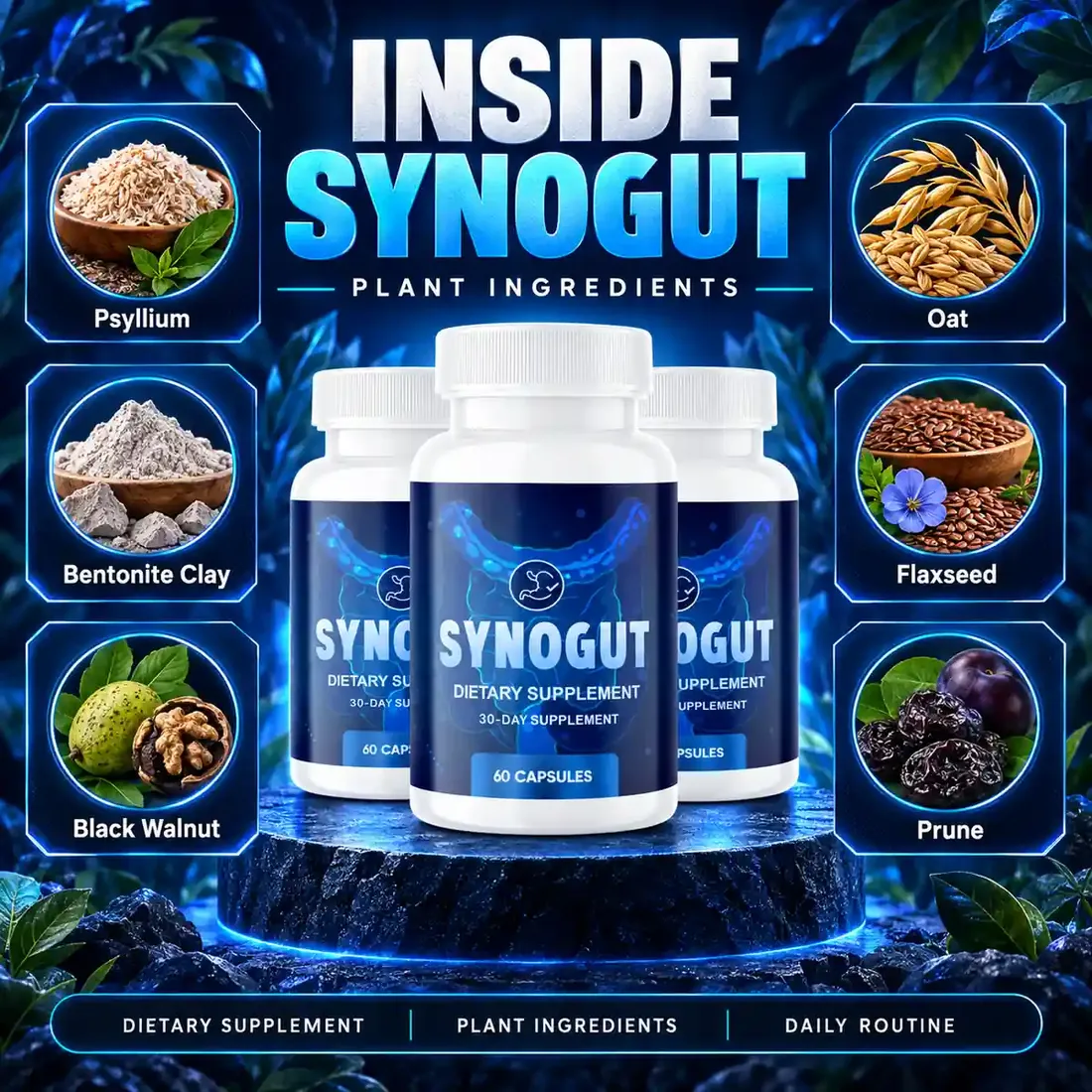
Synogut contains six named ingredients: psyllium, bentonite clay, black walnut, oat, flaxseed and prune.
The bottle art does not list amounts. The info site also names aloe vera, L. acidophilus, apple pectin and glucomannan.
Want the label view? Read the Synogut supplement facts.
Synogut names six plant and mineral ingredients on its bottle art: psyllium, bentonite clay, black walnut, oat, flaxseed and prune. No amount is published for any of them.
Flip a card to see what human studies used for each one.
Not stated
Plantago husk: a gel-forming soluble fiber
What studies used
Above 10 g of fiber a day, for 4 weeks or more
Two capsules likely hold 1-2 g of everything combined. (van et al., 2022)
Not stated
A volcanic clay (montmorillonite) that binds water and other substances
What studies used
No established dose
FDA found lead in some clay products, and clay can bind medicines. (FDA, 2016)
Not stated
Juglans nigra, usually the hull; rich in tannins
What studies used
No established dose
Evidence for gut worms or digestion is insufficient. Tannins may cut drug absorption. (RxList, n.d.)
Not stated
Avena sativa; oat fiber carries beta-glucan
What studies used
3 g a day of oat beta-glucan (a heart claim)
That is a heart-health figure, not a digestion dose. (21 CFR 101.81, n.d.)
Not stated
Linum usitatissimum seed: fiber plus plant oils
What studies used
About 10 g a day in one small trial
That trial baked flaxseed into cookies for 12 weeks. (Soltanian et al., 2018)
Not stated
Dried plum (Prunus domestica): fiber and sorbitol
What studies used
80-120 g of whole prunes a day
Studies used whole fruit, tens of grams, not powder. (Lever et al., 2019)
The serving size and the missing panel are covered on the Synogut supplement facts page.
Different sources show different Synogut formulas. The bottle art and seller pack name six ingredients, while the info site's text names ten.
No Supplement Facts panel settles which list is current, so the label on your own bottle is the one that counts.
| Source | Ingredients named | What it lists |
|---|---|---|
| Bottle art and the seller's “Inside Synogut” graphic | 6 | Psyllium, bentonite clay, black walnut, oat, flaxseed, prune |
| Info site text (thesynogut.com) | 10 | The same six plus aloe vera, L. acidophilus, apple pectin and glucomannan |
| A paid press release | Not a full list | Mentions “Lycopene 5%” |
| A third-party seller's review | Not verified | Says an Amazon “Synogut” leads with a 40 billion CFU probiotic and lacks flax, prune and clay |
Three of the six Synogut ingredients are fibers: psyllium, oat and flaxseed. Psyllium is a gel-forming soluble fiber, oat fiber carries beta-glucan, and flaxseed adds fiber plus plant oils.
Psyllium has the strongest record of the three. A 2023 guideline from two U.S. gut medicine groups backs fiber for chronic constipation, and psyllium was the only fiber that clearly helped (Chang et al., 2023).
Our article on psyllium study doses walks through the trial numbers in more detail.
Bentonite clay and black walnut are the two Synogut ingredients with the least support. Clay is a volcanic mineral that binds water and other substances, and black walnut hull is rich in tannins.
FDA once found high lead levels in a clay powder sold for drinking (FDA, 2016). That warning covered one product, not Synogut, but no heavy-metal test of Synogut has been published.
Long-term oral use is rated possibly unsafe. It may lower potassium and iron (RxList, n.d.).
Evidence is not strong enough to rate it for gut worms or digestion (RxList, n.d.).
Both can latch onto other things in the gut, so timing around medicines matters.
The lead question gets a full write-up in our bentonite clay article.
Prunes are in Synogut because dried plums carry both fiber and sorbitol, a natural sugar alcohol. Whole prunes are a classic food for regularity.
In a 4-week trial, 120 adults who ate 80 or 120 grams of prunes a day passed heavier stools than those who drank water alone (Lever et al., 2019). Gas was more common with prunes.
A smaller trial, funded by the California Dried Plum Board, gave prunes or psyllium at about 6 grams of fiber a day (Attaluri et al., 2011). Prunes did a little better.
A capsule share of prune powder is a tiny fraction of a handful of prunes, so this research does not carry over.
Nobody can say for sure, because Synogut publishes no amounts. What capsule size does tell us is that the doses are almost certainly far below the studies.
Even a large size 00 capsule holds under 1 gram of dense powder (UNC Pharmlabs, n.d.). Two capsules likely hold about 1 to 2 grams of all six ingredients combined. That is our estimate from capsule size, not a label figure.
The amount is not stated. Two capsules likely hold about 1-2 g of all six ingredients combined, an estimate from capsule size. Sources: (van et al., 2022) (Christodoulides et al., 2016)
Prune studies used whole fruit. A capsule share of prune powder cannot come close. Sources: (Lever et al., 2019) (Attaluri et al., 2011)
One 12-week trial in adults with type 2 diabetes. The Synogut amount is not stated. Sources: (Soltanian et al., 2018)
Synogut amount dose range used in human studies (log scale)
Not according to the bottle art. Aloe vera, L. acidophilus, apple pectin and glucomannan show up only in the info site's text, not on the Synogut bottle images.
If your label lists any of them, here is what each one is.
| Ingredient | On the bottle art? | What to know |
|---|---|---|
| Aloe vera | No | Aloe latex was taken out of over-the-counter laxatives in 2002, and oral latex can cause cramps and diarrhea (NCCIH, 2025). |
| L. acidophilus | No | No strain or CFU count is given, and probiotic effects depend on both (NCCIH, 2019). |
| Apple pectin | No | Pectin was one of the fibers that helped in a review of fiber trials, at doses above 10 g a day (van et al., 2022). |
| Glucomannan | No | A swelling fiber; drug labels for it must carry a choking warning (21 CFR 201.319, n.d.). |
Your own bottle is the final word on what Synogut contains. These steps take about two minutes.
Look on the back or side of the bottle for the boxed panel.
Compare it with the six on the bottle art.
Each ingredient needs its own amount, or a blend needs a total weight (FDA, 2005).
Note any probiotic, aloe or glucomannan line.
Questions about the formula go to the order desk at +1 (302) 200-3480.
If the bottle looks different from the pictures, the batch check page explains what to look at next.
Questions people type into Google and Bing, answered from the label and the sources on this page.
The bottle art names six: psyllium, bentonite clay, black walnut, oat, flaxseed and prune. No amounts are published.
The amount is not stated. Psyllium trials used about 10 to 19 grams a day, while two capsules likely hold about 1 to 2 grams of every ingredient combined (UNC Pharmlabs, n.d.).
Long-term oral use is rated possibly unsafe, and clay may bind medicines (RxList, n.d.). FDA has also warned about lead in one clay product.
It is a folk remedy rich in tannins. There is not enough evidence to rate it for gut worms, and its tannins may cut how well medicines are absorbed (RxList, n.d.).
Prunes carry fiber and sorbitol. Trials used 80 to 120 grams of whole fruit a day (Lever et al., 2019), far more than a capsule holds.
The bottle art lists none. The info site's text names L. acidophilus but gives no strain or CFU count, and probiotic effects depend on both (NCCIH, 2019).
Aloe vera is not on the bottle art. It appears only in the info site's ingredient text, so check the label on the bottle you receive.
One small 12-week trial found that about 10 grams a day of flaxseed, baked into cookies, improved constipation scores more than placebo (Soltanian et al., 2018). The Synogut amount is not stated.
The bottle art shows six, the info site's text shows ten, and a press release mentions lycopene. No published label settles it.
Glucomannan is on the info site's ten-item list but not on the bottle art. If your label lists it, take each serving with a full glass of water (21 CFR 201.319, n.d.).