Synogut Side Effects: What to Know Before You Start
Written by the Synogut editorial team
Last updated · Who reviewed this page · How we write and review
The most likely Synogut side effects are gas and bloating from its fibers.
Swelling fibers need a full glass of water. Clay, psyllium and walnut may bind medications, so space your doses and ask a doctor first if you take any.
For timing tips, see how to take Synogut.
Does Synogut have side effects?
Synogut itself has never been tested in a published study, so its own side effects are unknown. What we know comes from research on its ingredients, one by one.
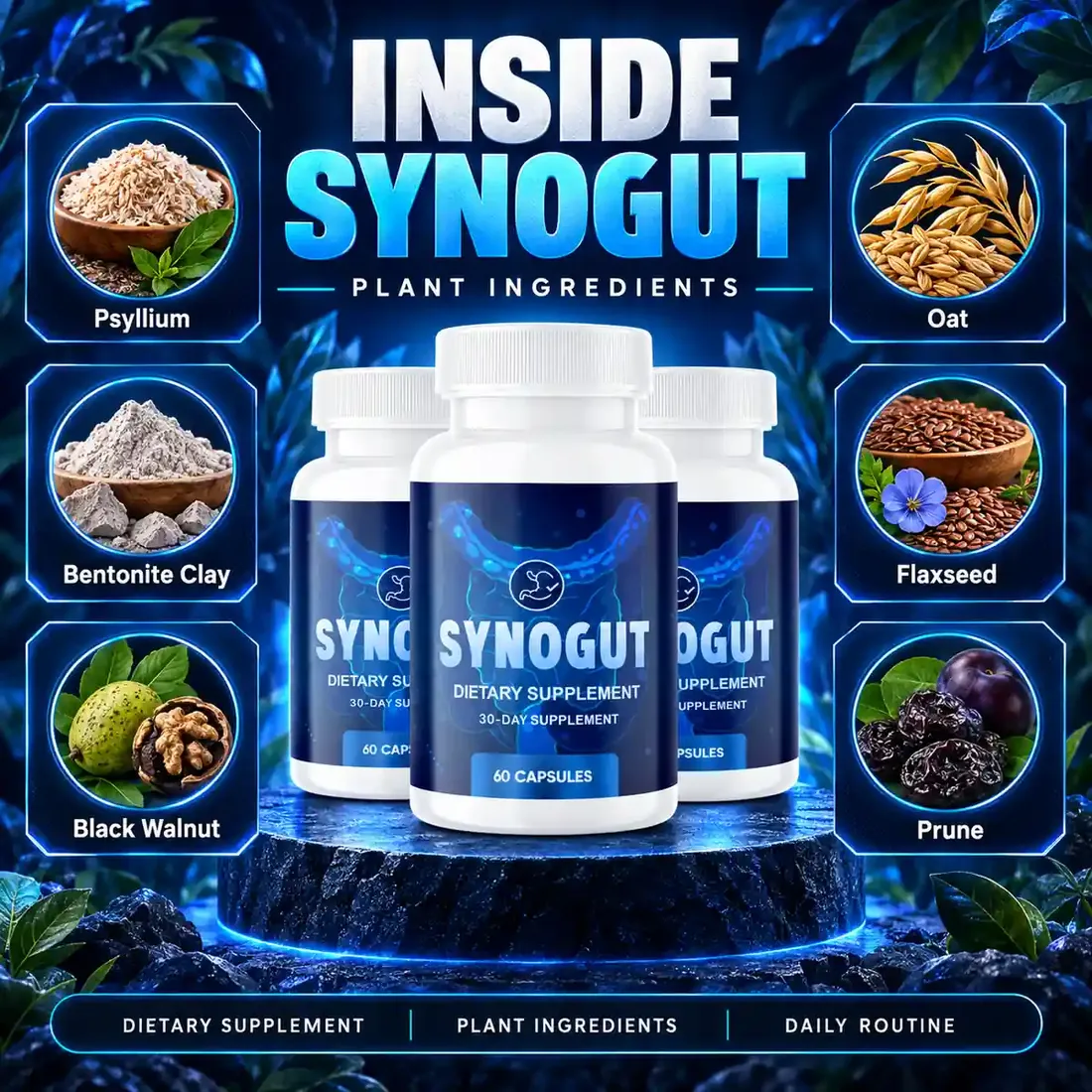
Two facts make this harder. No amounts are published for any ingredient, and two ingredient lists are in circulation: six names on the bottle art and ten in the info site's text. Read the list on the bottle you receive.
Most common
Gas and bloating. Both showed up more often with fiber in the trials.
Most urgent
Choking or blockage if swelling fibers go down without enough water.
Most easily missed
Clay, psyllium and walnut tannins may bind medicines and cut how much you absorb.
Synogut ingredient safety table
Each Synogut ingredient has its own safety note. The table pairs every name with its main caution. Four rows cover names found only on the info site's list.
| Ingredient | Where it is listed | Main safety note | Source |
|---|---|---|---|
| Psyllium | Bottle art and info site | Swells with water; needs a full glass; keep it apart from some medicines | (MedlinePlus, 2024) |
| Bentonite clay | Bottle art and info site | Lead found in some clay products; may bind medicines and nutrients | (FDA, 2016) |
| Black walnut | Bottle art and info site | Weak evidence; tannins may cut drug absorption | (RxList, n.d.) |
| Oat | Bottle art and info site | Often cross-contaminated with gluten unless certified | (CDF, n.d.) |
| Flaxseed | Bottle art and info site | Gas is a common fiber effect; no specific caution in our sources | (van et al., 2022) |
| Prune | Bottle art and info site | More gas with daily prunes in one trial | (Lever et al., 2019) |
| Glucomannan | Info site only | A swelling fiber with the same choking warning as psyllium | (21 CFR 201.319, n.d.) |
| Aloe vera | Info site only | Aloe latex can cause cramps and diarrhea | (NCCIH, 2025) |
| L. acidophilus | Info site only | No strain or count given; effects depend on strain and dose | (NCCIH, 2019) |
| Apple pectin | Info site only | A fiber; gas was more common with fiber in trials | (van et al., 2022) |
Can Synogut cause gas, bloating or loose stools?
Synogut may cause gas or bloating, especially at first. Gas was more common with fiber supplements than with placebo in a review of 16 trials (van et al., 2022). People eating 80 to 120 grams of prunes a day also had more gas than those drinking water (Lever et al., 2019).
The usual advice is to add fiber slowly and drink plenty of liquids (NIDDK, 2018). Stop if the discomfort is strong or does not settle.
Can the fibers in Synogut cause choking or a blockage?
Yes, if they go down without enough fluid. Psyllium and glucomannan swell when wet. Drug labels for these fibers must warn that they can swell, block the throat and cause choking (21 CFR 201.319, n.d.).
Those labels must also say to take each dose with at least 8 ounces of water or other fluid. MedlinePlus says to stop psyllium if you have trouble swallowing or breathing (MedlinePlus, 2024).
Do not take fiber capsules if you
- Have trouble swallowing
- Have a narrowed bowel or a past bowel blockage
- Cannot drink a full glass of water with each serving
Is the bentonite clay in Synogut safe?
The clay is the least certain part of Synogut. In 2016, FDA found high lead levels in a bentonite clay powder sold for drinking and told people not to use it (FDA, 2016).
Eating clay long-term is rated possibly unsafe. It may lower potassium and iron, may cause lead poisoning, and may reduce how well some medicines are absorbed (RxList, n.d.).
No independent lab report or heavy-metal test for Synogut has been published. The lot and certificate numbers we hold are draft labels, not lab proof. Our article on bentonite clay in gut supplements covers what is known.
Does the black walnut in Synogut interact with medicines?
It may. Black walnut hull is rich in tannins, and tannins may reduce how well medicines taken by mouth are absorbed (RxList, n.d.).
There is not enough evidence to rate black walnut for intestinal worms, and no dose has been set.
Which medicines need spacing or a doctor's check before Synogut?
Any daily medicine deserves a check with your doctor or pharmacist before Synogut. Psyllium, clay and walnut tannins can all bind medicines in the gut, which may lower how much you absorb.
MedlinePlus says to keep psyllium about 3 hours apart from some medicines and to separate it from others (MedlinePlus, 2024). Supplements can interact with medicines, so tell every provider what you take (NIH ODS, 2023).
| Medicine | Synogut ingredient involved | What the source says |
|---|---|---|
| Digoxin (a heart medicine) | Psyllium | Keep about 3 hours apart |
| Aspirin | Psyllium | Keep about 3 hours apart |
| Nitrofurantoin (an antibiotic) | Psyllium | Keep about 3 hours apart |
| Any other daily medicine | Psyllium | Separate the doses; ask your pharmacist how far |
| Medicines taken by mouth | Bentonite clay | Clay may reduce absorption |
| Medicines taken by mouth | Black walnut tannins | Tannins may reduce absorption |
| Low iron or low potassium | Bentonite clay | Long-term clay may lower both |
Bring the bottle to your appointment. Natural does not always mean safe (NCCIH, 2019). The how-to-use page covers daily timing.
Does the oat in Synogut carry a gluten risk?
Yes, it may. Synogut is not shown to be gluten free. It lists oat, and oats are easily cross-contaminated with gluten unless they are labeled gluten-free (CDF, n.d.).
A gluten-free claim means the product holds less than 20 parts per million of gluten (McKinnon et al., 2022). No such claim or certificate appears for Synogut, so people with celiac disease should ask a doctor first.
What about the extra ingredients on the info site's Synogut list?
The info site's text lists four ingredients that the Synogut bottle art does not show: aloe vera, L. acidophilus, apple pectin and glucomannan. Check your own bottle to see which list it follows.
Each one brings its own note. Aloe latex was removed from over-the-counter laxatives in 2002 over missing safety data (NCCIH, 2025). Probiotic effects depend on the strain and dose, and no strain or count is given (NCCIH, 2019).
Who should not take Synogut without a doctor's OK?
Pregnant or nursing women, anyone with a medical condition and anyone on daily medicines should ask a doctor before Synogut. The seller pack says it is for adults 18 and over.
The groups below need a clear yes from their doctor first. The who it is for page sets out the full fit.
- Children and teens under 18
- People who have trouble swallowing or a narrowed bowel
- Anyone on daily medicines, including heart drugs and antibiotics
- People with low iron or low potassium
- Anyone with an ongoing bowel condition
When do gut symptoms need a doctor, not Synogut?
Some symptoms need a doctor right away, not a supplement. These include blood in the stool, black stool, constant belly pain, vomiting, fever and weight loss without trying (NIDDK, 2018).
Synogut does not treat constipation, IBS, IBD, parasites or any bowel disease. Adults 45 to 75 should have colon cancer screening, however regular they feel (USPSTF, 2021).
What to do if you react to Synogut
If something feels wrong on Synogut, stop taking it first. Then match your next step to how serious the symptom is.
- 1
Stop the capsules
Skip the next serving. Do not push through a reaction.
- 2
Get urgent help if severe
Call 911 for choking, trouble breathing or trouble swallowing.
- 3
Watch for red flags
Blood in the stool, black stool or severe belly pain means a prompt doctor visit.
- 4
Call your doctor
Bring the bottle so they can read the ingredient list you actually have.
- 5
Contact the order desk
For a refund, call +1 (302) 200-3480 with your order ID.
Read how our medical reviewer checks the safety wording on this site.
Synogut side effects: common questions
Questions people type into Google and Bing, answered from the label and the sources on this page.
What are the side effects of Synogut?
Synogut itself has never been tested, so its own side-effect rate is unknown. Its ingredients point to gas and bloating from fiber, a choking risk without enough water, and clay and walnut tannins that may bind medicines.
Can Synogut cause gas or bloating?
It may. Gas was more common with fiber supplements and with daily prunes than with placebo or water in the trials. Adding fiber slowly with plenty of liquid is the usual advice.
Is bentonite clay dangerous?
It can be. Long-term clay eating is rated possibly unsafe because it may lower potassium and iron and cause lead poisoning. Clay may also cut how well some medicines are absorbed.
Does bentonite clay contain lead?
Some products have. In 2016, FDA found high lead levels in a bentonite clay powder sold for drinking and told people not to use it. No heavy-metal test for Synogut has been published.
Can black walnut interact with medications?
It may. The tannins in black walnut may reduce how well medicines taken by mouth are absorbed. There is also not enough evidence to rate black walnut for gut worms.
Can aloe vera cause diarrhea?
Yes. Oral aloe latex can cause cramps and diarrhea, and FDA had it removed from over-the-counter laxatives in 2002. Aloe appears only on the info site's list, not the Synogut bottle art.
Can fiber supplements cause a blockage?
They can if you take them without enough fluid. Drug labels for psyllium and glucomannan must warn that they can swell and block the throat. People with a narrowed bowel should not take fiber capsules.
Who should avoid bentonite clay?
Anyone on daily medicines should ask a doctor first, since clay can bind them. People with low iron or low potassium, and pregnant or nursing women, should also check before using any clay product.
Does the Synogut label carry warnings?
The back-label caution text was not shown in the material we have. The seller pack says Synogut is for adults 18 and over, and to keep it out of reach of children.