How Does SynoGut Work? A 101 Walk Through the Formula, Fiber to Clay
Written by the Synogut editorial team · Medically reviewed by Dr. Will Bulsiewicz, MD, Physician
Last updated · Review date: October 16, 2026 · Who reviewed this page · How we write and review
SynoGut is meant to work as a daily fiber habit. Psyllium forms a gel with water, and oat, flaxseed and prune add more fiber, while clay and black walnut round out the six-name list. That is the design idea. No study has tested the finished formula, and no ingredient amount is published.
Key facts
- The idea is simple: take the capsules with water every day, and let the fibers do what fibers do.
- Psyllium is a gel-forming soluble fiber and is the best-studied of the six named ingredients.
- Oat, flaxseed and prune add fiber, and prune brings sorbitol, a sugar alcohol found naturally in the fruit.
- Clay and black walnut have the weakest evidence, and both may bind medicines.
- Fiber trials judged results after 4 weeks or more, so one capsule day shows little.
- We found no published study of SynoGut itself, and the maker publishes no results timeline.
How does SynoGut work, in simple terms?
Think of it as a small fiber plan in a capsule. You swallow the serving with water. The fibers meet the water in your gut. They hold it, soften what is there and add gentle bulk. That is the theory behind most fiber products, and it is the one the formula follows.
The seller's own graphic is a three-step picture. Step one shows what is inside. Step two shows what it supports. Step three says every day, with a note that there is no subscription. It shows no amounts and no timeline, so it describes how the product is sold, not what happens in the body.
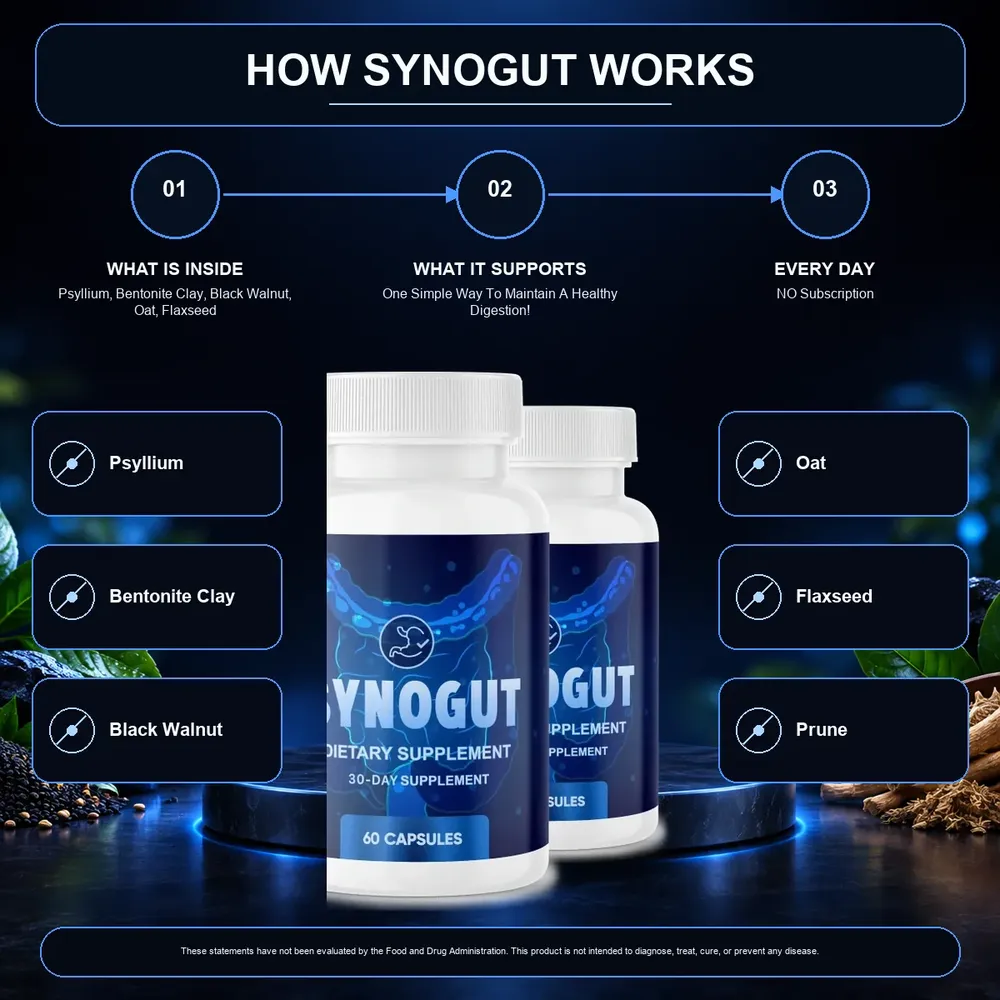
This is the closest thing to a 101 guide that the seller provides. It is short on numbers on purpose, so we fill in the context from public sources.
Where a fact is missing, we say so. Where a study exists, we name it and show its size.
What happens at each step of the formula?
- Step 1
Capsules and a full glass of water
The bottle math points to 2 capsules a day. Swelling fibers need at least 8 oz of fluid with each serving (21 CFR 201.319).
- Step 2
Psyllium meets water
Psyllium forms a gel. In trials, fiber softened stools and raised how often people went (Christodoulides et al., 2016).
- Step 3
Oat, flaxseed and prune add fiber
Each brings its own fiber. Prune adds sorbitol too. Whole prunes raised stool weight in a 4-week trial (Lever et al., 2019).
- Step 4
Clay and walnut join in
Clay binds water and other substances. The hull of black walnut holds a lot of tannins. Neither one has good digestion data.
- Step 5
Repeat daily
Trials judged results after at least 4 weeks, so steady use matters more than one dose.
Why is psyllium the star of the formula?
Because it has the most research. Across seven trials pooled in 2016, 77% of adults on fiber responded, while 44% did on placebo (Christodoulides et al., 2016). A bigger 2022 review saw benefit above 10 grams a day for at least 4 weeks (van der Schoot et al., 2022). The 2023 U.S. guideline backs psyllium for chronic constipation (Chang et al., 2023).
These are good signs for the fiber. They do not describe the capsule. Those adults had chronic constipation and took large daily doses. SynoGut states no psyllium amount, so we cannot say how close it comes.
Is there enough room in a capsule for the fibers to work?
Room is the main limit. A size 00 capsule holds about 929 mg of lactose powder, and a size 000 holds about 1,340 mg (UNC Pharmlabs). Fiber husk is usually lighter than lactose, so a capsule holds even less by weight.
Add up two capsules shared among six ingredients, and you land near 1 to 2 grams in total. We worked that out from capsule size, and no label prints it. Trials of psyllium used about 10 to 19 grams a day.
| Source | Grams a day | Note |
|---|---|---|
| Adult food-fiber advice | 22 to 34 | From meals, added slowly |
| Psyllium in trials | About 10 to 19 | One fiber, measured |
| Prune fiber in one trial | About 6 | From whole prunes |
| Two SynoGut capsules, six ingredients in total | About 1 to 2 (estimate) | Nothing published per ingredient |
What do bentonite clay and black walnut add?
The sales pages do not say. Clay is a volcanic mineral that binds water and other substances. Black walnut hull is a folk remedy rich in tannins. A drug and supplement reference sets no dose for clay and rates long-term oral use as possibly unsafe (RxList, clay).
FDA found high lead in one bentonite clay powder sold for drinking and told people not to use it (FDA, 2016). That warning named one product, not SynoGut. Still, no heavy-metal result for this capsule has been published, so the question stays open.
Binding is also a medicine issue. Both ingredients may reduce how well pills are absorbed, so space them from your medicines and ask your pharmacist. None of this is detox. Little good research shows that clay or any cleanse removes toxins (NCCIH, 2025).
What is still unproven about how SynoGut works?
- No study of the finished formula exists, so its effect on people is unmeasured.
- No amount is published, so no ingredient can be matched to a trial dose.
- Two ingredient lists are in circulation: six names on the bottle art and ten in the info site's text.
- No customer timeline has been matched to a real order.
- The maker is not named, and no independent lab report is published.
A fair reading is this. The design idea is sound as far as fiber goes. The proof for this exact capsule is missing.
What are the price and guarantee facts?
| Pack | Price per bottle | Pack total | Supply |
|---|---|---|---|
| 2 bottles | $79 | $158 plus a $9.99 shipping tag | 60 days |
| 3 bottles | $69 | $207, free U.S. shipping | 90 days |
| 6 bottles | $49 | $294, free U.S. shipping | 180 days |
All three packs come with the 60-day money-back promise. You claim it by phone, and the buyer pays tracked return shipping. SynoGut is a dietary supplement that FDA does not approve, so ask your doctor before you start if you take medicines.
Frequently asked questions
Here are the how-it-works questions people ask most, answered without hype.
How does SynoGut work?
The idea is a daily fiber habit. Psyllium forms a gel with water and other fibers add bulk. No study tested the finished formula, so this is a design idea.
Does SynoGut really work?
Psyllium helped adults with chronic constipation in trials at about 10 grams a day or more. A capsule serving likely holds far less, and no study tested SynoGut itself.
What is SynoGut 101?
It is a dietary supplement in capsules. A bottle holds 60 capsules and is labeled 30-Day Supplement, with six ingredient names on the bottle art.
Does SynoGut need water?
Yes. Swelling fibers need at least 8 oz of fluid per serving, and people who have trouble swallowing should not take them.
Why are clay and black walnut in the formula?
The sales pages do not explain. Clay binds water and other substances, black walnut is a folk remedy, and both may bind medicines.
How long before SynoGut starts working?
The maker publishes no timeline. Fiber trials judged results after at least 4 weeks of steady use.
Our view
Our view: the logic behind SynoGut is ordinary fiber logic. Water, gel, bulk and a daily habit. That part is easy to follow and not unusual. What is unusual is how little the label tells you about amounts.
Use it, if you do, as a small add-on to food fiber and fluids, and keep your medicines apart from it. If you want the strongest evidence for a fiber dose, a plain psyllium product that states grams is easier to judge. This is general information, not medical advice.
Last updated November 4, 2026.