Is SynoGut Safe With Your Medicines? How Far Apart Should You Space It?
Written by the Synogut editorial team · Medically reviewed by Dr. Will Bulsiewicz, MD, Physician
Last updated · Review date: October 16, 2026 · Who reviewed this page · How we write and review
Ask your doctor or pharmacist before taking SynoGut with any daily medicine. Psyllium, bentonite clay and black walnut tannins can bind drugs and cut how much you absorb. MedlinePlus advises about 3 hours between psyllium and digoxin, aspirin or nitrofurantoin. Take each serving with a full glass of water.
Key facts
- Three SynoGut ingredients can bind medicines: psyllium, bentonite clay and black walnut tannins.
- MedlinePlus says to keep psyllium about 3 hours apart from digoxin, aspirin and nitrofurantoin.
- For any other daily medicine, psyllium should be separated too. Your pharmacist can set the gap.
- Long-term clay use may lower potassium and iron.
- Each serving needs a full glass of water, at least 8 ounces for psyllium.
- No interaction study of the finished SynoGut formula exists.
Why can SynoGut affect medicines at all?
Because some of its ingredients cling to things in the gut. A medicine you swallow has to be absorbed through the gut wall. If something in the same meal grabs part of it, less may reach your blood.
SynoGut names three ingredients that can do this. Psyllium turns into a gel that can bind some drugs. Bentonite clay is a mineral that binds water and other substances. Black walnut hull is rich in tannins, which may lower absorption of oral medicines.
The word may matters here. These are effects described for each ingredient. No one has tested the finished capsule, and the amounts are not published. So we treat the risk as real but unmeasured.
Which medicines need a gap or a doctor's check?
| Medicine | Ingredient involved | What the source says |
|---|---|---|
| Digoxin (a heart medicine) | Psyllium | Keep about 3 hours apart |
| Aspirin | Psyllium | Keep about 3 hours apart |
| Nitrofurantoin (an antibiotic) | Psyllium | Keep about 3 hours apart |
| Any other daily medicine | Psyllium | Separate the doses; ask your pharmacist how far |
| Medicines taken by mouth | Bentonite clay | Clay may reduce absorption |
| Medicines taken by mouth | Black walnut tannins | Tannins may reduce absorption |
| Low iron or low potassium | Bentonite clay | Long-term clay may lower both |
The 3-hour figure comes from MedlinePlus, and it is given for psyllium with those three drugs (MedlinePlus, 2024). For clay and walnut, our sources say absorption may drop but give no hour count (RxList, clay, RxList, black walnut).
How far apart should you take SynoGut and a medicine?
Start from the 3-hour figure, then let your pharmacist adjust it. That figure is a floor for the three named drugs, not a promise for every drug.
A simple way to think about it is the day as a timeline. Mark the times you take your medicines, then keep SynoGut well clear of those marks.
- Step 1
List your medicines
Write every prescription, over-the-counter product and supplement, with the time you take each.
- Step 2
Show the bottle
Take the SynoGut bottle or a photo of the label to your pharmacist.
- Step 3
Pick one slot
Choose a daily time that sits clear of your medicine times, as your pharmacist advises.
- Step 4
Keep it steady
Use the same slot every day so the gap never drifts.
The label we hold gives no time of day, so the slot is your choice. These steps are habit ideas, not label directions.
Why does SynoGut need a full glass of water?
Because psyllium swells. Drug labels for psyllium must warn that it can swell and block the throat, and they ask you to take each dose with at least 8 ounces of liquid (21 CFR 201.319).
MedlinePlus repeats the 8 ounce rule and says to stop psyllium if you have trouble swallowing or breathing (MedlinePlus, 2024). Fiber capsules are not for anyone who already struggles to swallow or has a narrowed bowel.
Does the clay raise a separate safety question?
Yes. Beyond binding medicines, long-term oral clay is rated possibly unsafe. It may lower potassium and iron, and it may bring lead (RxList, clay).
FDA tested one bentonite clay powder sold for drinking in 2016, found high lead levels and told people to stop using it (FDA, 2016). That notice named one product, not SynoGut. But no heavy-metal test of the SynoGut clay is published, so the question stays open.
Our longer piece on bentonite clay in gut supplements walks through the lead warning in more detail.
Can you take SynoGut with other supplements?
Ask a pharmacist first. Clay may lower how much iron and potassium you absorb, so it can clash with a mineral product. The NIH also warns that more is not always better when you stack products (NIH Office of Dietary Supplements, 2023).
A good habit is to keep one list of everything you take. Share it with every provider, including the pharmacist who fills your prescriptions. A bottle of SynoGut belongs on that list.
- Name each supplement, with its dose, on one page.
- Mark the time of day you take each one.
- Update the page when anything changes.
What should you do if you react badly?
Stop the capsules first. Then match your next step to how serious it feels.
- Step 1
Stop
Skip the next serving rather than pushing through.
- Step 2
Get urgent help if severe
Call 911 for choking, trouble breathing or trouble swallowing.
- Step 3
Watch for red flags
Blood in the stool, black stool or severe belly pain means a prompt doctor visit.
- Step 4
Call your doctor
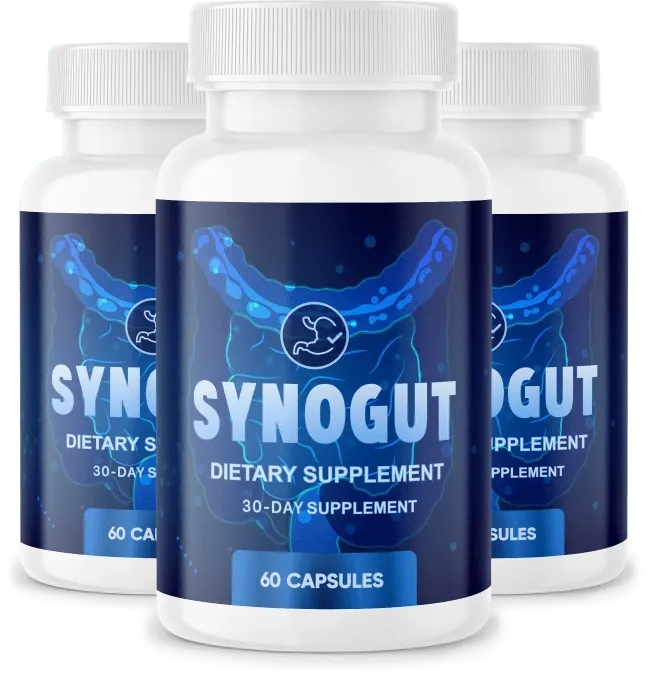
Bring the bottle so they can read the ingredient list you really have.
- Step 5
Tell the order desk
For a refund, call +1 (302) 200-3480 with your order ID.
What do we not know about SynoGut and medicines?
A fair amount. No interaction study of the finished formula exists. The ingredient amounts are not published, so we cannot size any effect. The back-label caution text was not supplied to us, and the label may carry advice we have not seen.
That is why the answer here is to ask a person who knows you. SynoGut is a supplement, not a drug. It is not FDA approved, and nothing here is medical advice.
| Fact | What is published |
|---|---|
| Guarantee | 60-day money-back. Claim by phone with your order ID. The buyer pays tracked return postage |
| Refund timing | 3-5 business days after the returns desk credits you, then 5-10 days on your card |
| Order desk | +1 (302) 200-3480 for orders, tracking and refunds |
| FDA status | Not FDA approved. No supplement is |
Frequently asked questions
Short answers on SynoGut and medicines, from MedlinePlus, RxList and the other sources named on this page.
Is SynoGut safe to take with my medicines?
Check with your doctor or pharmacist before you begin. Psyllium, clay and black walnut tannins can bind medicines and lower how much you absorb, and no study of the finished formula exists.
How far apart should I take psyllium and my medicine?
MedlinePlus advises about 3 hours between psyllium and digoxin, aspirin or nitrofurantoin, and says to separate it from other medicines too. A pharmacist can build a timetable around your own drugs.
Can I take SynoGut with other supplements?
Ask a pharmacist. Clay may lower iron and potassium absorption, and the NIH notes that more is not always better. Keep one list of everything you take.
Does SynoGut interact with blood pressure or heart drugs?
Heart drugs such as digoxin are named for a 3-hour gap with psyllium. For other heart or blood pressure drugs, no specific figure is published, so ask your pharmacist.
Why does SynoGut need so much water?
Psyllium swells as it soaks up liquid, and too little fluid can block the throat. Drug labels ask for at least 8 ounces of water with each dose.
What if I forget a gap and take both together?
Do not take extra capsules to make up for it. Go back to your usual spacing at the next dose, and ask your pharmacist whether that particular medicine needs special care.
Our view
The safest summary is short. Three SynoGut ingredients may bind medicines, one of them has a known 3-hour gap for three named drugs, and nobody has measured the effect in the finished capsule.
So the plan is dull and sound. Show the bottle to your pharmacist, pick a steady slot, drink a full glass of water, and keep your own list. If anything feels wrong, stop and call.
SynoGut is not a drug, it is not a cure and it is not FDA approved. Your doctor and pharmacist know your medicines. This page does not.
Last updated November 4, 2026.